
Real-Time Operating Systems and the Future of Industrial Edge Computing: Bridging IT, OT, and Zero Trust Architectures
- Jun 18
- 6 min read

Author: Eric Seme, CEO, Fireball Industries Article Summary
As industrial organizations modernize, traditional architectures such as the Purdue Model are failing to meet the demands of cybersecurity, AI, and distributed edge computing. This article examines how Real-Time Operating Systems (RTOSs), Zero Trust networking, and hyper-converged edge platforms are enabling a new generation of industrial architectures that finally bridge the gap between Information Technology (IT) and Operational Technology (OT).
Abstract
The convergence of Information Technology (IT) and Operational Technology (OT) is reshaping industrial operations. Manufacturers and critical infrastructure providers require platforms capable of delivering deterministic real-time control, edge AI, and enterprise integration from a single infrastructure. Traditional architectures based on the Purdue Model and isolated automation silos are increasingly inadequate. At the center of this transformation is the Real-Time Operating System (RTOS). Once limited to embedded controllers, modern RTOS platforms are evolving into foundational technologies that enable software-defined manufacturing and Zero Trust security.
This discussion is vendor-neutral and focuses on architectural patterns rather than specific products or services.
Introduction: The End of Traditional IT/OT Separation

For decades, industrial organizations operated under a simple assumption: OT and IT should remain separate. The Purdue Enterprise Reference Architecture formalized this via a hierarchy of layers that isolated production systems from enterprise networks.
That world no longer exists. Modern operations increasingly depend on remote access, cloud analytics, digital twins, and continuous improvement loops driven by data. As a result, IT and OT have become tightly interconnected. This convergence creates a fundamental challenge: industrial systems require deterministic real-time control, while enterprise systems prioritize flexibility, scalability, and rapid software change. The industrial edge has become the meeting point between these requirements, and RTOS technology is increasingly central to making the convergence workable.
Limitations of the Purdue Model in Modern Industrial Environments
The Purdue Model remains useful as a conceptual map of industrial functions, but it is often misapplied as a security architecture. In practice, many implementations rely on perimeter-based defenses and implicit trust assumptions that are often difficult to align with today’s connected operating environments.
Several trends have eroded the feasibility of strict “inside vs. outside” separation: pervasive IIoT telemetry, vendor and integrator remote access, multi-site operations, cloud-connected analytics, and the need to deploy new software faster than traditional change windows allow. These realities increase the likelihood that threats can appear in multiple places and that lateral movement becomes a primary risk if internal zones are flat.
For background on the Purdue Enterprise Reference Architecture, see: https://en.wikipedia.org/wiki/Purdue_Enterprise_Reference_Architecture
Zero Trust and the RTOS Foundation

Zero Trust is commonly summarized as “never trust, always verify.” In industrial environments, this translates into continuous verification, least-privilege access, and micro segmentation so that a compromise in one area does not automatically spread across the plant or across sites.
Guidance on applying Zero Trust concepts to OT has been published by organizations including the U.S. Department of Defense and Carnegie Mellon University’s Software Engineering Institute (SEI): https://dodcio.defense.gov/Portals/0/Documents/Library/ZT-OperationalTechnologyActivitiesOutcomes.pdf and https://www.sei.cmu.edu/blog/it-ot-and-zt-implementing-zero-trust-in-industrial-control-systems/
A modern edge platform must enforce these security policies without compromising operational performance. This is where the RTOS becomes essential. Unlike general-purpose operating systems that optimize average throughput, an RTOS prioritizes predictability. In many industrial contexts, a computation that is logically correct but late is still a failure. Applications such as motion control, high-speed vision, protection relays, and closed-loop process control may require deterministic timing measured in microseconds to milliseconds.
Hyper-Converged Infrastructure (HCI) at the Industrial Edge
Security and determinism are necessary, but not sufficient. Industrial operators also need operational simplicity and resilience. Traditional architectures often separate compute, storage, networking, and security into different products and management planes. Hyper-Converged Infrastructure (HCI) collapses these functions into a software-defined platform running on commercial off-the-shelf (COTS) servers.
At the edge, HCI enables a resilient cluster model: if one node fails, workloads can be restarted on healthy nodes. When combined with centralized fleet management and declarative configuration, HCI reduces manual configuration drift and helps standardize security controls across distributed sites.
The Rise of Software-Defined Manufacturing
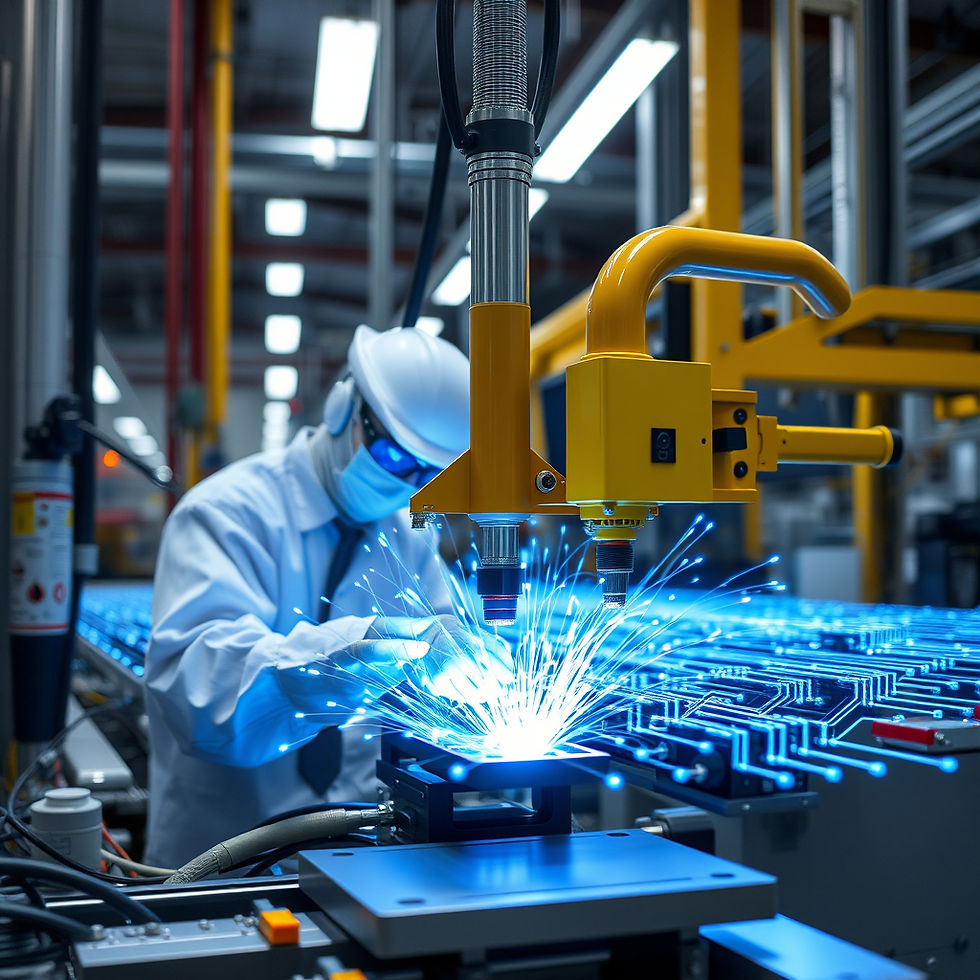
Manufacturing is undergoing a transition similar to the virtualization of data centers. Physical infrastructure is being abstracted into software, allowing manufacturers to update capabilities without replacing hardware. Software-defined manufacturing represents a shift from hardware-centric automation architectures toward software-managed operational environments. Similar to the transformation of enterprise IT through virtualization and cloud computing, manufacturing systems are increasingly being deployed, versioned, and governed through software-defined platforms.
This shift enables consolidation of high-value edge workloads, including:
• FDA 21 CFR Part 11 compliance capabilities that support data integrity and e-signature controls in regulated environments.
• Edge AI and machine vision for low-latency quality inspection using GPU acceleration.
• AMR/AGV orchestration for coordinating autonomous fleets across dynamic shop-floor layouts.
• Energy management and electrical monitoring for higher-frequency operational visibility and control.
For a discussion of evolving edge-to-cloud industrial architectures, see: https://www.controleng.com/edge-to-cloud-understanding-new-industrial-architectures/
Edge AI and Determinism Industrial AI is moving from the cloud to the edge because many operational decisions cannot tolerate cloud latency or connectivity loss. However, AI inference workloads can be bursty and resource-intensive. A real-time edge architecture helps ensure that AI workloads do not starve safety- or timing-critical control loops of CPU cycles, memory bandwidth, or network priority.
Cybersecurity and Immutable Infrastructure

Many next-generation edge platforms are adopting immutable operating system patterns. In an immutable system, core OS layers are read-only, and updates are applied as atomic image replacements with rollback to a known-good state. This approach can reduce persistence opportunities for malware and makes fleet-wide configuration more repeatable.
When immutability is combined with Zero Trust principles such as mutual authentication, least-privilege access, and microsegmentation, organizations can materially reduce attack surfaces and limit lateral movement opportunities for threat actors.
Additional background on immutable operating system concepts: https://thenewstack.io/3-immutable-operating-systems-bottlerocket-flatcar-and-talos-linux/ Economic Drivers: Predictable Pricing and Platform Consolidation
Industrial modernization decisions are increasingly shaped by economics and operational capacity. Many organizations face labor constraints, rising cybersecurity costs, and complex vendor ecosystems. A common pain point is licensing that scales linearly with fleet size (or example, per-node licensing fees), which can make long-term operating costs difficult to predict.
Unified edge platforms can reduce complexity by consolidating device management, workload orchestration, secure connectivity, and application hosting into fewer products and fewer integration points. For many manufacturers, cost predictability (fixed tiers, fewer meters) becomes as important as raw performance.
The Future: Unified Industrial Operations

The future factory will be increasingly software-defined, where the boundary between IT and OT is less about network diagrams and more about governance, safety, and operational intent. In that environment, successful architectures are typically:
Secure by design (identity-first, policy-driven access).
Deterministic where required (real-time control remains protected from resource contention).
AI-capable at the edge (low-latency inference with operational guardrails).
Resilient and self-healing (clustered workloads that survive node failures)
Conclusion The Purdue Model was a necessary framework for its time, but many real-world deployments struggle to satisfy modern cybersecurity, connectivity, and agility requirements using perimeter-based assumptions alone. The convergence of IT and OT is pushing industrial organizations toward architectures built on Zero Trust principles, hyper-converged infrastructure, and deterministic compute foundations.
As industrial organizations pursue digital transformation initiatives, the convergence of IT, OT, cybersecurity, and artificial intelligence will continue to accelerate. Success will depend on platforms capable of combining deterministic operational performance with the flexibility, scalability, and security expected of modern enterprise systems.
Real-Time Operating Systems are not being displaced by cloud-native technologies; they are increasingly the stable layer that allows modern orchestration, networking, and AI to operate safely in the physical world. Author Bio Eric Seme is CEO of Fireball Industries, leading the development of industrial edge computing, AI, and Zero Trust platforms. His work focuses on converging IT and OT systems through secure, deterministic architectures. Learn more at https://fireballz.ai and connect on LinkedIn at https://www.linkedin.com/in/ericseme. Bibliography
1. Buttazzo, G. C. (2011). Hard Real-Time Computing Systems: Predictable Scheduling Algorithms and Applications. Springer.
2.Williams, T. J. (1994). The Purdue Enterprise Reference Architecture (PERA)
3. Purdue Enterprise Reference Architecture (overview): https://en.wikipedia.org/wiki/Purdue_Enterprise_Reference_Architecture
4. Carnegie Mellon University SEI. IT, OT, and Zero Trust: https://www.sei.cmu.edu/blog/it-ot-and-zt-implementing-zero-trust-in-industrial-control-systems/
5. U.S. DoD CIO. Zero Trust for Operational Technology Activities and Outcomes: https://dodcio.defense.gov/Portals/0/Documents/Library/ZT-OperationalTechnologyActivitiesOutcomes.pdf
6. Control Engineering. Edge to cloud: Understanding new industrial architectures: https://www.controleng.com/edge-to-cloud-understanding-new-industrial-architectures/
7. The New Stack. Immutable operating systems overview: https://thenewstack.io/3-immutable-operating-systems-bottlerocket-flatcar-and-talos-linux/


